


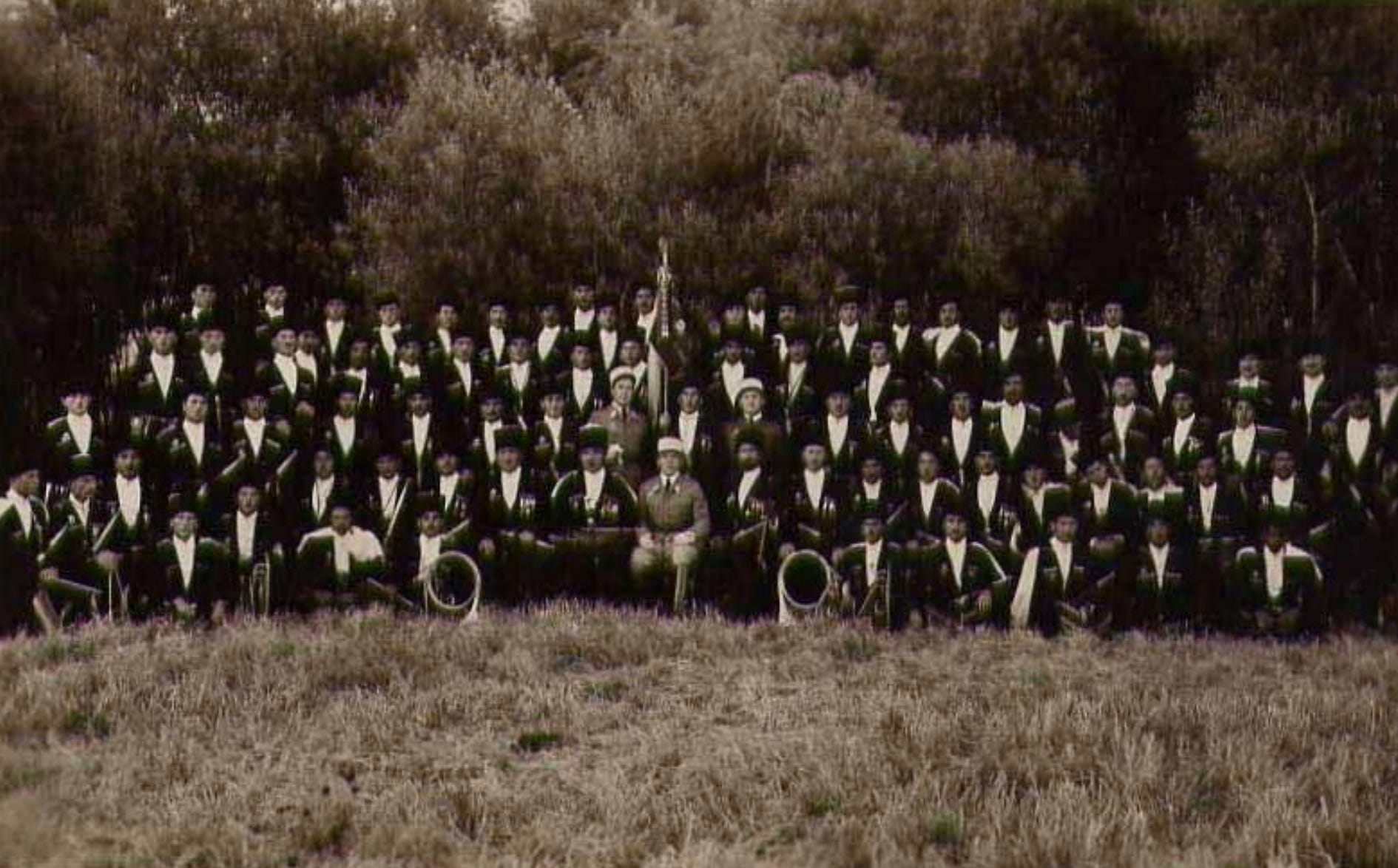
Just before midnight on 2 November 1925, a hundred and fifty Circassian cavalrymen were camped near Kalaat-Djendal, in the hills south of Damascus. They had spent the autumn chasing Druze rebel bands across the Ghouta and the approaches to Soueida, and they had earned a night’s rest. They did not get one. Druze fighters fell on the camp in the dark, and what followed was close, ugly, hand-to-hand fighting among the tents and horse lines.
By dawn the squadron had ten dead and thirteen wounded. It had also killed some seventy of the attackers and inflicted around three hundred casualties in total. A unit that had ridden into the ambush a hundred and fifty strong rode out barely a hundred strong.
It should have been the end of the story. Instead, Kalaat-Djendal became the seed of something bigger. Within weeks, three new squadrons had been raised around that battered core. Within a year, there were eight. The men doing this fighting were exiles from the Caucasus, recruited by a French officer who had learned their language, and for the better part of two decades they carried their mountain traditions, their weapons and their horsemanship into somebody else’s colonial war.
Exile to the Levant
Circassians, the Adyghe people of the north-west Caucasus, did not choose Syria. Russian imperial conquest pushed them out of their homeland in a mass expulsion that peaked in 1864, and the Ottoman Empire settled them across Anatolia, Palestine, Jordan and Syria. When the French Mandate replaced Ottoman rule in 1920, it inherited a Circassian population still, two generations on, distinctly Caucasian in dress, in custom and in its instinct for the saddle. The French had a use for that.
Collet finds his cavalry
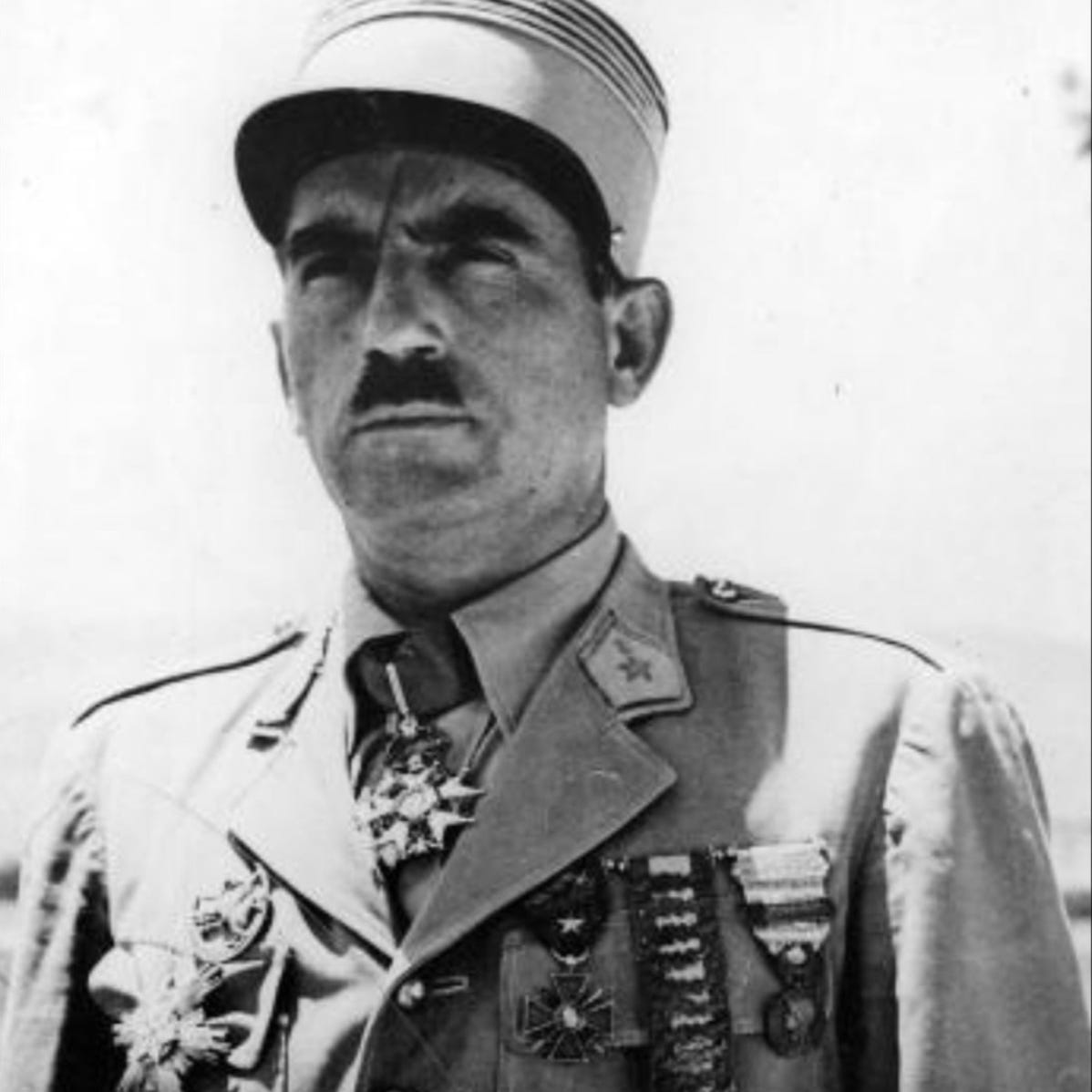
Philibert Collet was born in Sidi-Bel-Abbès, in French Algeria, on 12 December 1896, the son of Joseph Collet and Dolorès Hurtado. He enlisted at eighteen and spent the First World War with the 9th Régiment de Marche de Tirailleurs Algériens, fighting in the Somme in 1916 and through the German counter-offensive in Picardy in the summer of 1918. Wounded twice, he ended the war with four citations, a Croix de Guerre, and a Chevalier’s cross of the Légion d’Honneur, awarded on the battlefield that October, aged twenty-one.
Peace in Europe did not interest him much. In 1919 he volunteered for the Levant, serving with the 412th Infantry Regiment and then the 1st Régiment de Tirailleurs Algériens. In 1920, leading first a section and then an irregular groupe franc, he helped open the road to Homs, adding four more citations to his record. By November he had moved into the Levant’s intelligence service, combining militia command with the job of administrative adviser to a caza, a Syrian district. Two years later he was at Aleppo, commanding a mobile gendarmerie squadron, when he noticed something: a detachment of Circassian horsemen serving alongside him who would not break and would not desert.
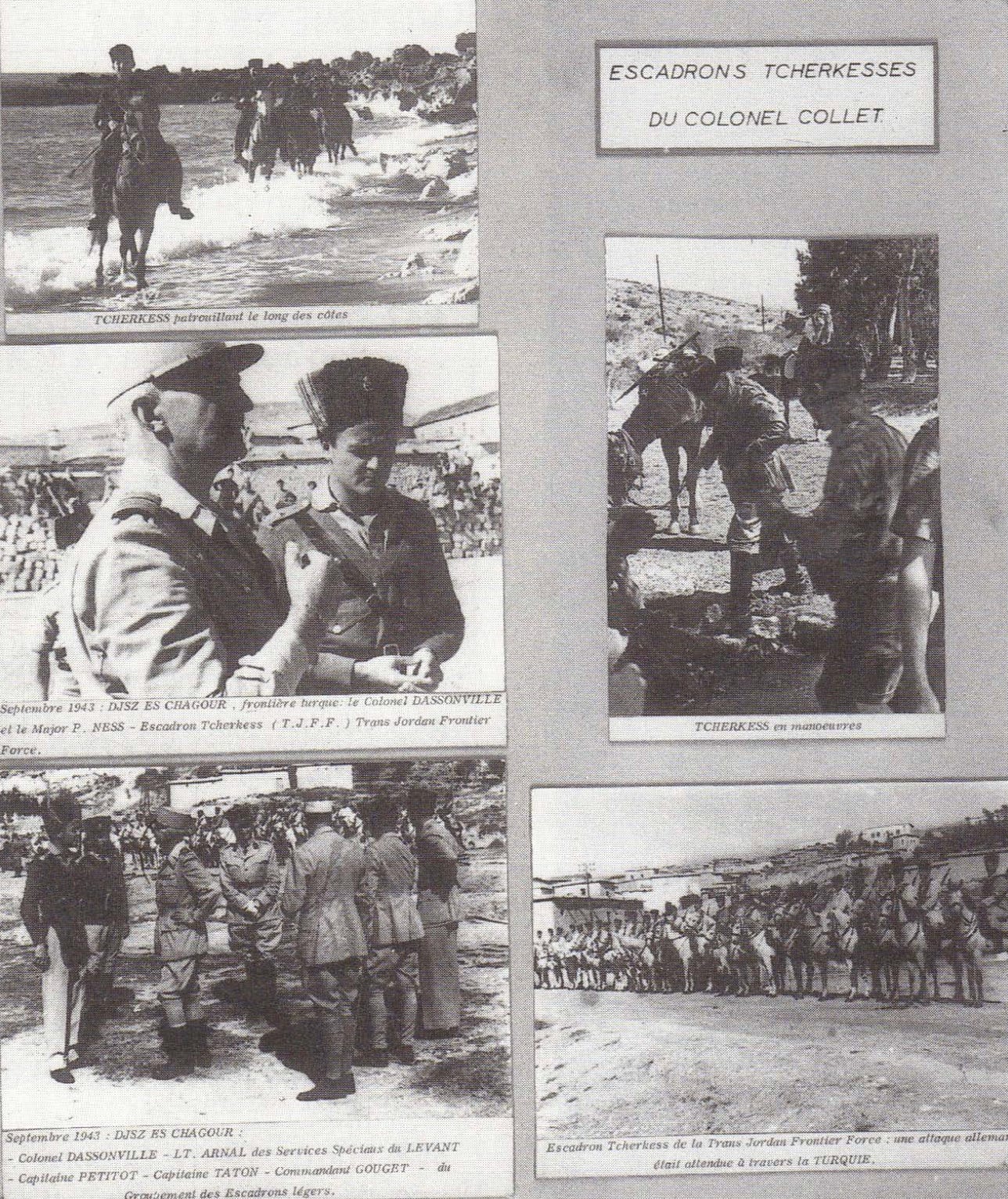
He said as much himself, years later, to a French journalist touring the Levant. During the first Druze uprising of 1921, he recalled, Syrian gendarmes deserted or went over to the rebels wholesale; only one unit held its ground, the Circassian squadron. Collet asked to serve alongside its commander, Iman Bey, and together they raised its strength to a hundred and fifty men, recruited around Quneitra.
Working with two Circassian officers, Toufik Bey and Osman Bey, Collet’s men helped pacify the Idlib and Hadjilar districts between 1922 and 1924, then moved into the Djebel Druze. Hadjilar and Djebel Druze became the first two names embroidered on the unit’s future standard. His own men, meanwhile, gave him a title: they elected him émir, the way the Ismailis of Syria looked to the Aga Khan, and it was not a formality. Officers under his command later told visitors he was the only man they knew who would ride into a fight unarmed and still hold their obedience, because he gave his orders in their own language.
Eight squadrons, ten battle honours
When the Great Syrian Revolt broke out in the Djebel Druze in the summer of 1925, Collet asked to take his First Squadron into the field. In September it rode as vanguard cavalry with the Gamelin Column’s advance on Soueida, the Druze capital, taking Tell i-Hadid on the 23rd and reaching the citadel alone, two hours ahead of the main column, on the 24th. Brought back to Damascus in October for the city’s own uprising, the squadron spent nearly two weeks fighting through the Ghouta before Kalaat-Djendal all but destroyed it in November.
What came out of that ambush was not a broken unit but a founding one. Three fresh squadrons were raised that same month under Osman Bey, Toufik Bey and a third Circassian commander, Hadji Acha, each a hundred and fifty strong, with French lieutenants attached to liaise. The Groupement Tcherkess now existed as a formal command, under Collet, and it barely had time to organise before the fighting resumed. Through the winter the squadrons were in action almost continuously, at Medjel Chems, Otaya, Harasta, Deraya, and in a bruising night action south of Yelda on New Year’s Eve. In February a Druze band under Chekib Ouahab cost the Tcherkess their heaviest single loss yet, twenty-one men killed at a place called Halvi.
By March 1926 a fifth squadron had been added, deliberately mixed this time, bringing Ismaili, Kurdish, Druze and Chammar recruits in alongside the Circassian core and widening the unit’s reach into rival communities’ intelligence networks. That same month, at Katana, some twelve hundred rebels tried the Kalaat-Djendal trick again, surprising four squadrons by night. This time the cavalry held, fighting house to house and killing forty-two attackers for the loss of seven of their own.
Two months later came the action the sources hold up as the model of everything this unit did well. At the end of May, working from solid intelligence, Collet secretly assembled four squadrons at Sassa, rallied two more overnight, and rode eight kilometres to encircle a rebel band at Joubbat el-Khachab before it knew he was coming. Forty-one of the enemy died, including their commander and his brother; the Tcherkess captured a machine gun and lost two men. By midsummer two more squadrons had joined, bringing the total to eight: eight times the strength of the single unit that had ridden into Soueida less than a year before.
The rest of 1926 read like a ledger of hard, grinding actions: a sweep of the Ghouta in July that took the rebel headquarters at Bala farm for twenty-eight dead, including two Circassian lieutenants; a night march over the mountains to storm the supposedly impregnable Djebel Berber in August; the destruction of the Akkache band near Mazraba in September. The worst came in October, when the squadrons finally cornered the most dangerous rebel force still in the field, led by a former French-trained captain named Faouzi and Emir Izzeddine. The fighting through the Ghouta orchards killed Osman Bey, the Circassian officer who had stood beside Collet from the beginning and had already lost three family members to this war, and an eighteen-year-old Druze driver famous in the unit for his devotion to Collet. The Tcherkess lost thirty-five men in this single engagement and inflicted well over sixty on the other side.
It is worth being honest about why men kept riding into this. The pay was good by regional standards, and French commanders permitted the squadrons a degree of licence to take plunder from the bands they broke, according to later academic research into the campaign. That does not make the courage on display any less real, but it complicates any account that wants to make this a simple story of loyalty for its own sake.
The rebellion had one more act. Emir Izzeddine, having taken refuge in the Safa desert, pushed back into the Ghouta in May 1927 with roughly a hundred and fifty men. After hard fighting near Bala farm on the 17th, his band was trapped and wiped out near Dereidj two days later. Izzeddine died there, along with both his lieutenants. The Tcherkess lost their own standard-bearer, an adjutant named Hadj-By, in the final fighting inside a cave where the last rebels made their stand. The sources on this campaign treat Dereidj as the close of the squadrons’ heroic period, and it is not hard to see why.
Across roughly two years of this fighting, the Groupement lost around three hundred cavalrymen killed, twenty of them officers. Ten names went onto the standard: Hadjilar, Djebel Druze, Kalaat-Djendal, Medjel Chems, Katana, Joubbat el-Khachab, Ghouta, Maaraba, Anti-Liban, Dreidje. The unit earned seven citations to the order of the army, and in 1927 Collet was made an Officier of the Légion d’Honneur.
The horsemen’s own world
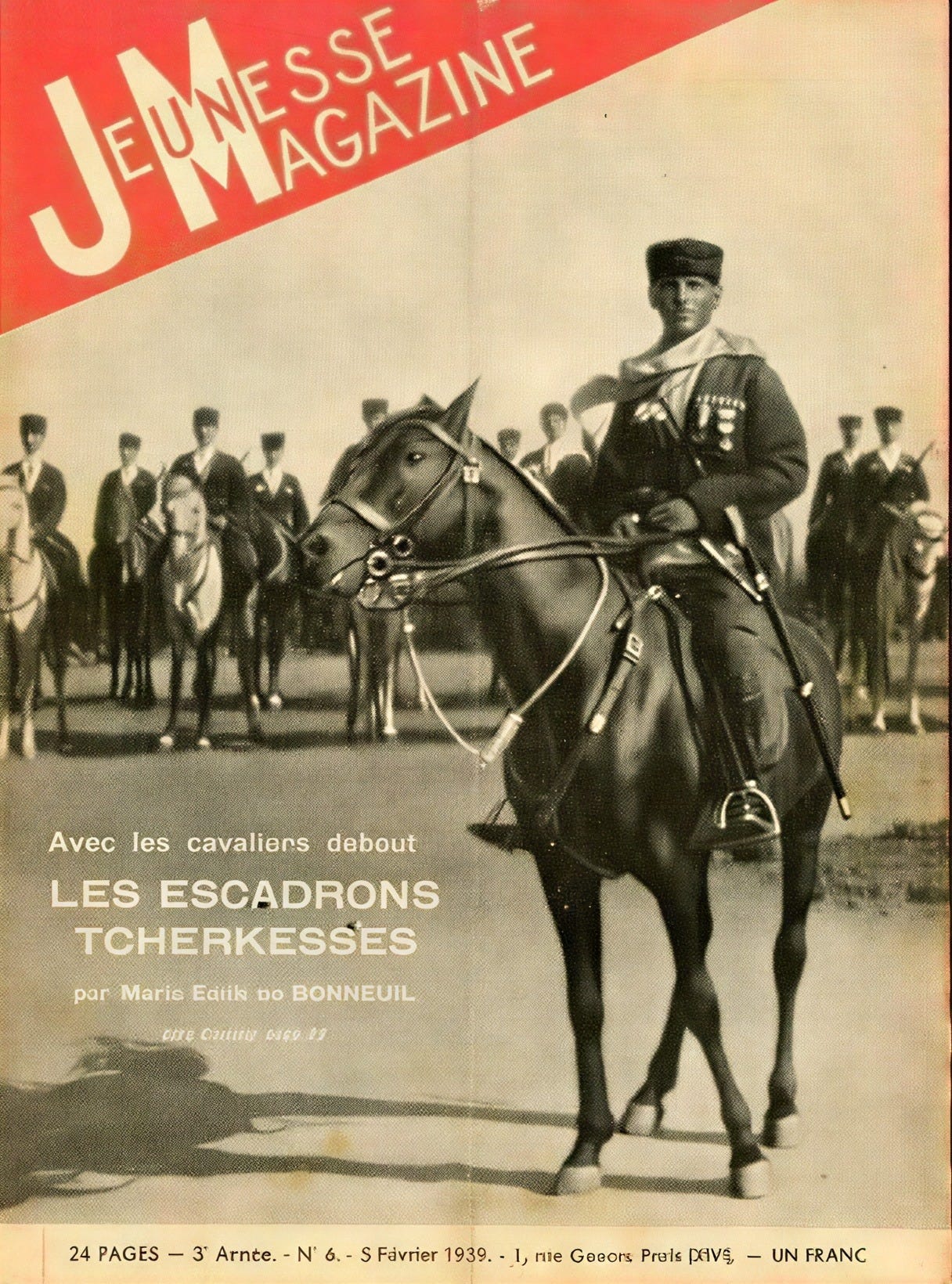
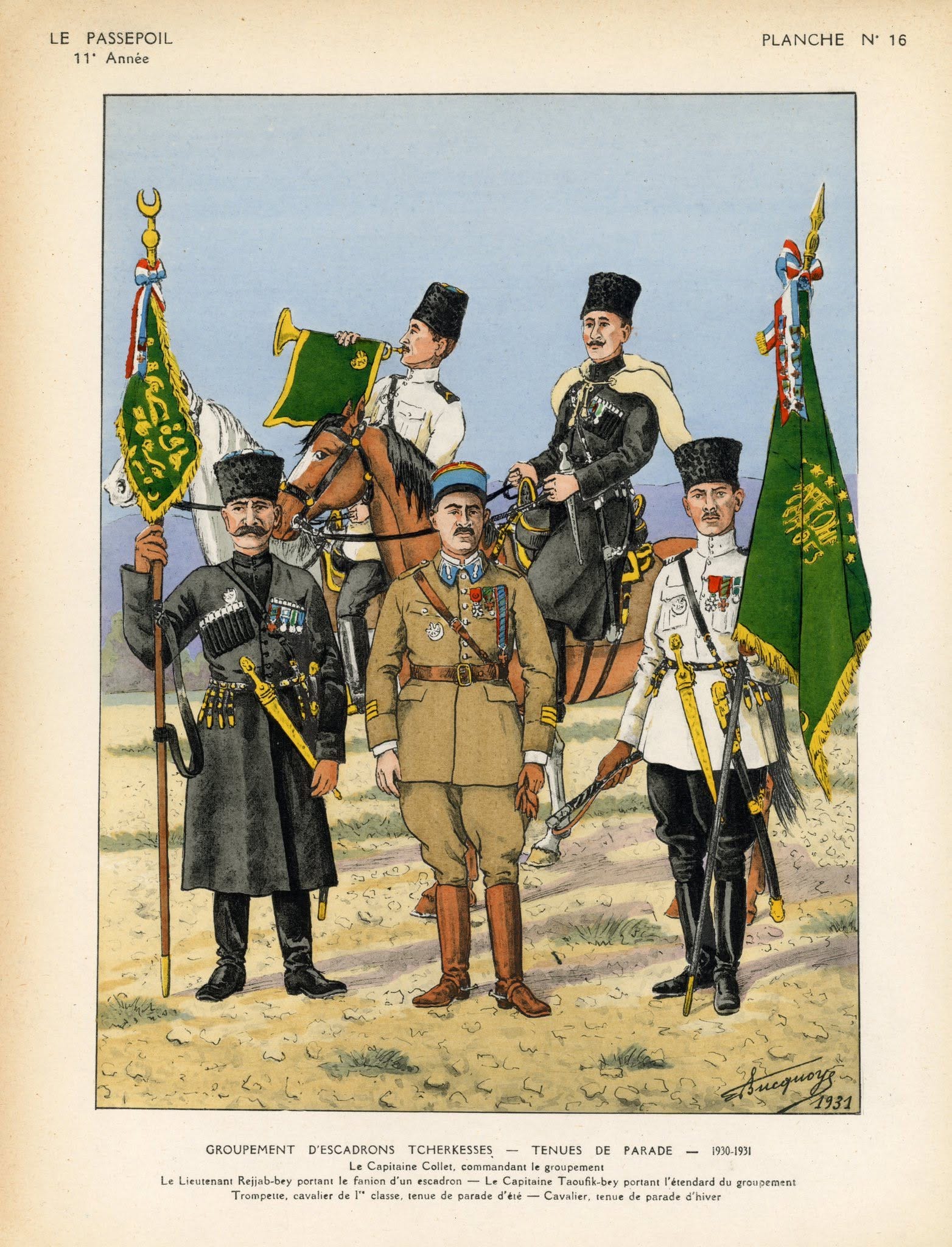
None of this looked like a French colonial unit from the outside, and that was rather the point. The parade dress was pure north Caucasus: a collarless blouse called the kaptal fetsa, black in winter and white in summer, worn under the tsé, a tunic open in a V across the chest and fitted with rows of false cartridge cases, the gazyrs, carved from wood, bone, ivory or silver and sewn diagonally into the fabric. Cossacks called this same garment the tcherkesska. Over the shoulders went the bachlik, a white hooded cape against the weather, and on the head sat the kalpack, a cylindrical black astrakhan cap with a pale blue crown and crossed braid, gold for officers, yellow for the rank and file.
Alongside the Mauser and later Model 1916 carbines that French cavalry carried everywhere, the Tcherkess kept their own weapons: the nagaika, a plaited leather whip whose silver-niello handle often hid a small dagger or a revolver barrel behind a hidden catch; the kindjal, a straight forty-centimetre dagger with a silver or gold hilt, which men rarely let out of their reach; and the chachka, a hilt-less sabre up to a metre long, slung from a black leather belt studded with silver.
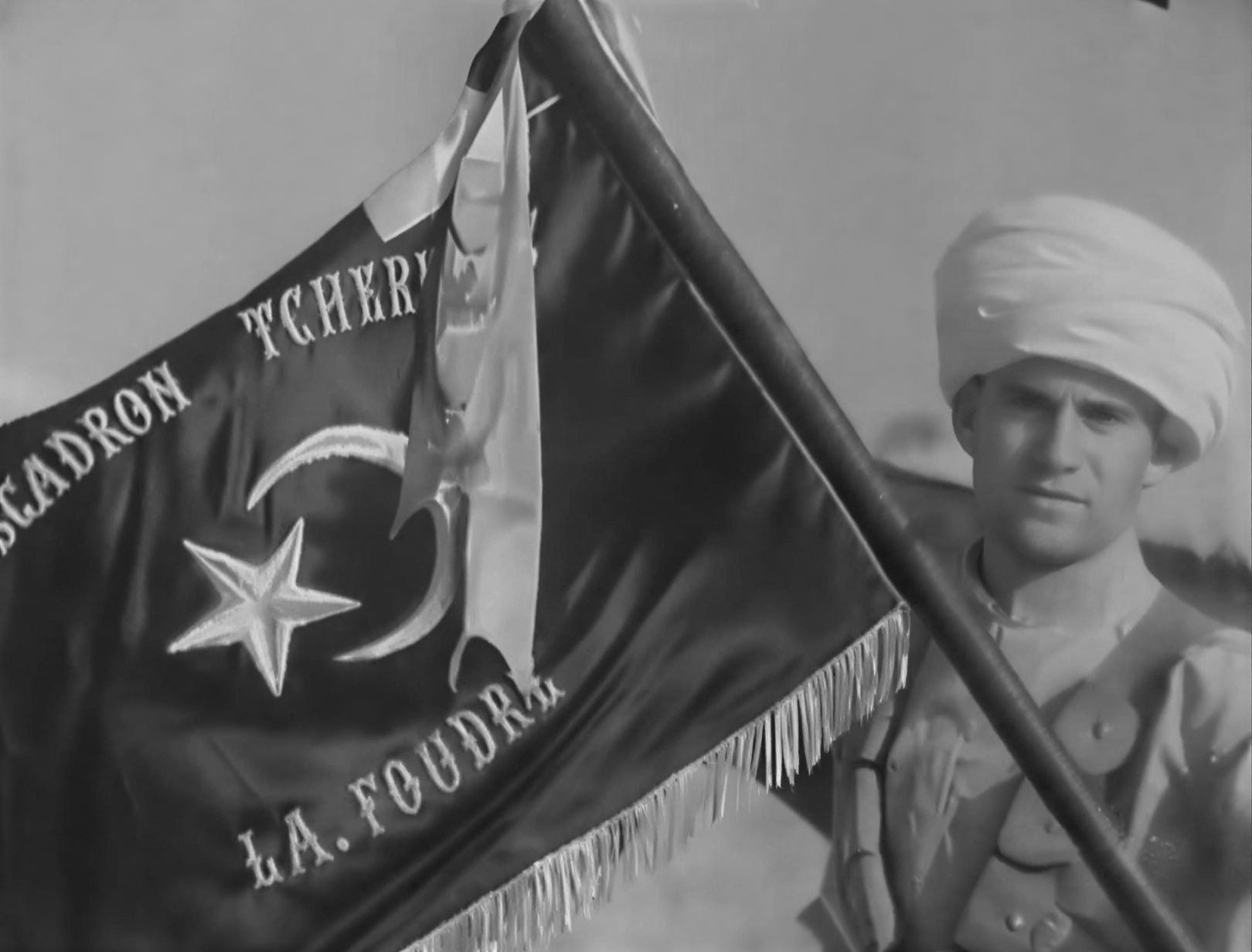
The unit’s badge, made by the Paris firm Chobillon in 1930, showed a mounted Tcherkess in full parade dress, nagaika in hand and kindjal at his belt, framed by a crescent and a six-palm Croix de Guerre. The standard itself, green silk, dated 1930 and now held in the Salle des Drapeaux at the Musée de l’Armée in Paris, carries all ten battle honours on its face. Turn it over and the writing is in Circassian: ‘Yapeqhe Tcherkess’, Circassians, forward, above seven stars for the seven principal Circassian tribes. Individual squadron fanions carried their own colours and nicknames: green for most, the colour associated with the Prophet, black for the fourteenth squadron, white for the sixteenth; the twelfth called itself ‘la foudre’, the thunderbolt, and the fifteenth ‘l’invincible’.
A journalist who travelled with the squadrons in the late 1930s left one of the few outside descriptions of Collet himself: a lean, dark-haired man in his early forties, met bare-headed and in shorts, a length of brown cotton wound round his neck against the dust, riding ahead of his troops in a Ford with a switch in his hand. When she asked one of his oldest Circassian officers, Toufik Bey, what made the men follow him, he told her that Collet was the bravest man alive, the only one who went into battle unarmed, and the only French officer who could give a Tcherkess an order in his own tongue.
A frontier crossed in secret
Collet left the Groupement in January 1938 to command a battalion of Moroccan Tirailleurs near Antioch and Alexandretta. He was back in Damascus by October 1940, under a French state that had surrendered to Germany, and rebuilt a force of Circassian partisans fourteen squadrons strong, ostensibly to watch the frontier with British-held Transjordan and Palestine. That post gave him a channel to General Georges Catroux, the Free French commander for the Middle East, and he used it, receiving Gaullist emissaries at real risk to himself under a regime that would have called it treason.
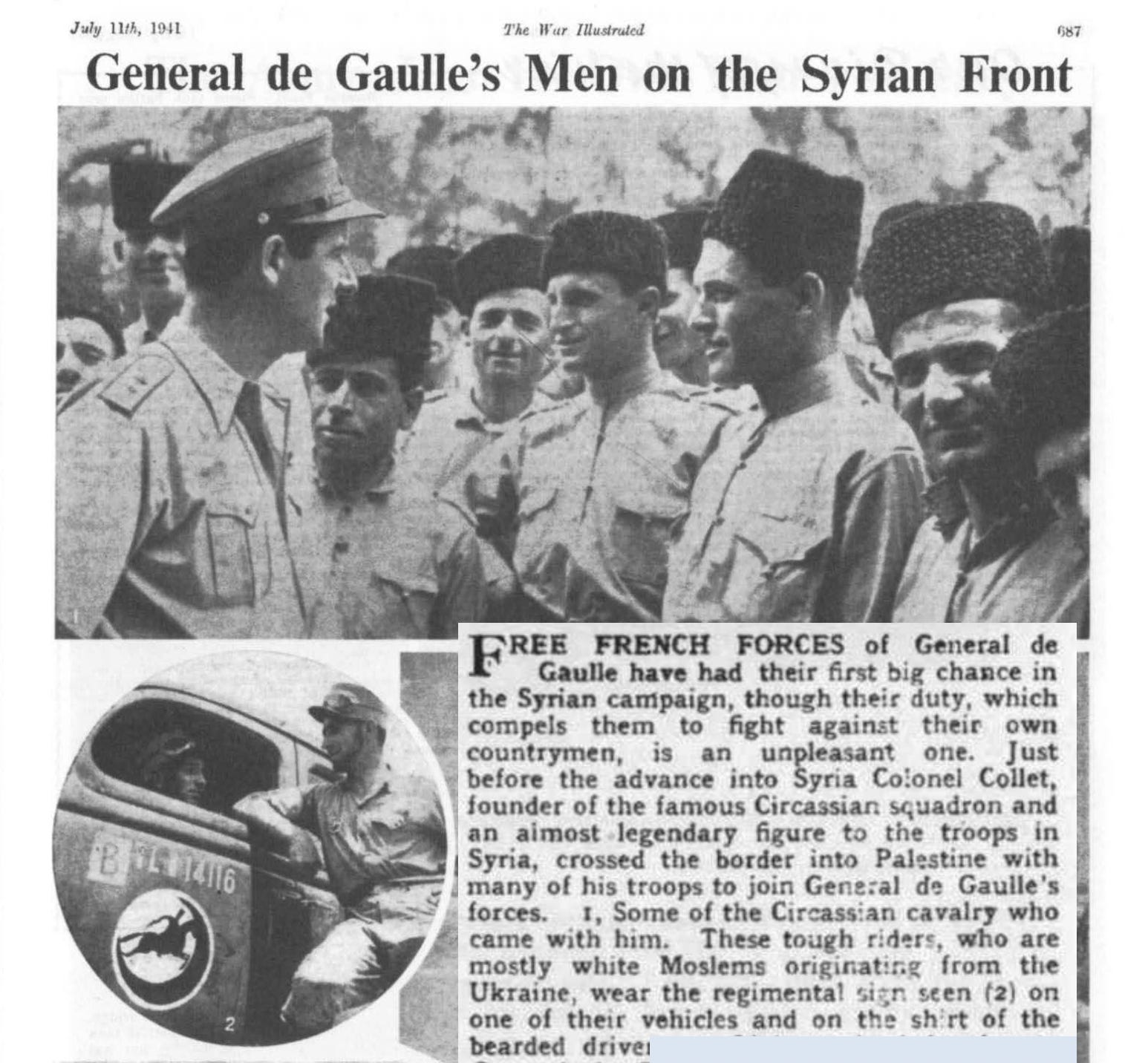
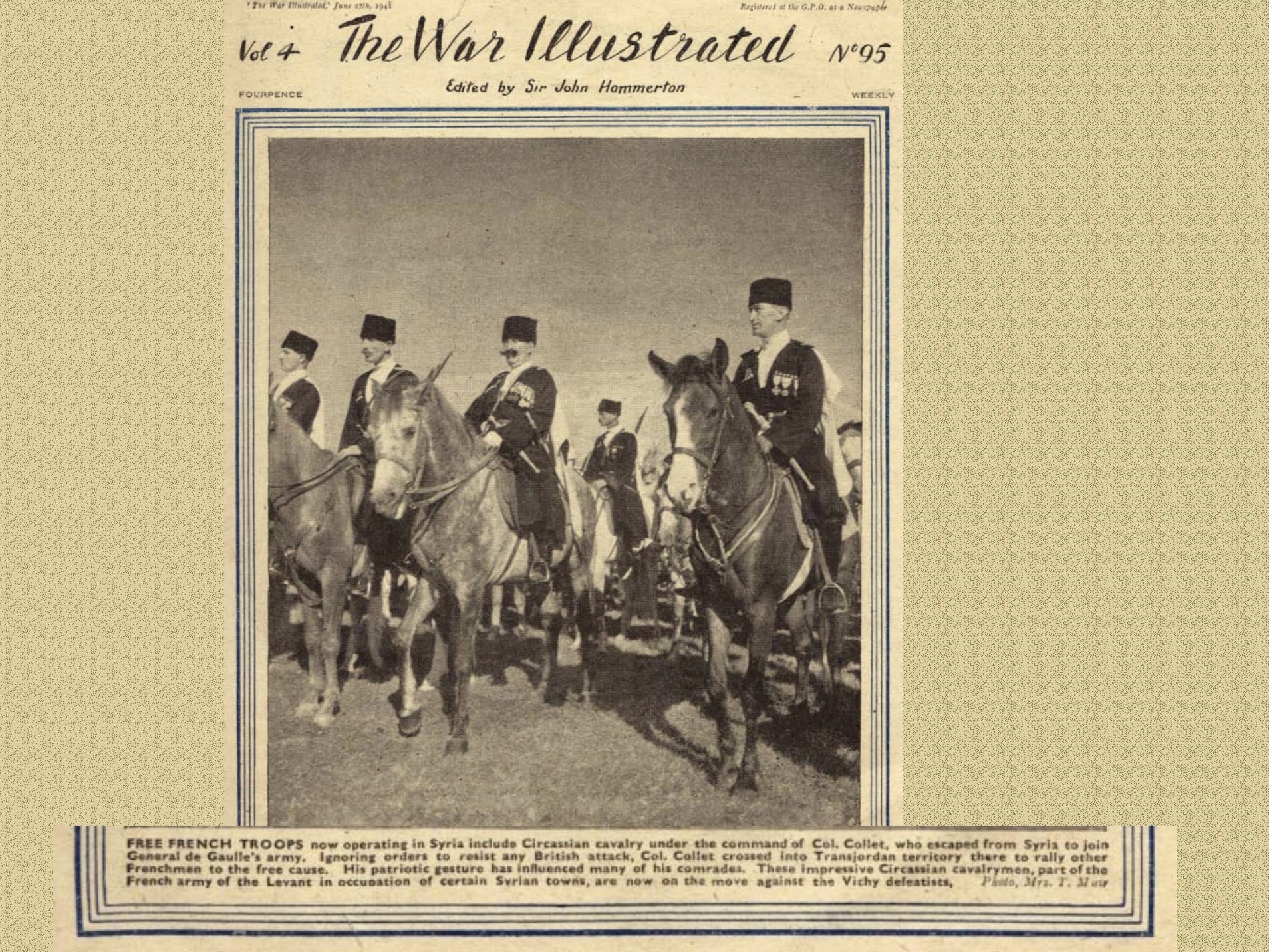
The break came in May 1941, when Vichy France signed the Paris Protocols, opening Syrian air bases to German aircraft supporting an anti-British revolt in Iraq. Collet protested to the Vichy High Commissioner, General Henri Dentz, and was ignored. On 20 May he crossed the Syrian-Transjordanian frontier in secret, at the Deraa border post, to meet Catroux in person. The bulk of his men, something like four hundred and fifty of them by most counts, twenty-three officers, thirty NCOs and around four hundred Circassian cavalrymen, followed him across the same border the next day and were received at Irbid by a squadron commander of the 1st Moroccan Spahis. Vichy struck Collet from the army list and stripped him of his French nationality on 24 May. Two days later, de Gaulle himself came to the frontier with General Legentilhomme to salute the unit that had just defected to him.
Free French propaganda seized on the story almost as soon as it happened, which says something about how useful a picturesque colonial rallying was to a movement still short of legitimacy in 1941. What that propaganda left out is that most of the Groupement did not follow Collet at all. The squadrons that stayed behind remained loyal to Vichy and fought against the British and the Free French that June, which means Circassian cavalrymen ended up shooting at each other under two flags within weeks of each other. Collet, now a colonel, led the cavalry group of the Legentilhomme Division from 8 June and was named Free French delegate at Damascus that same month. He was made a brigadier general in August, later commanded the Meknès military region in Morocco, and received the Croix de la Libération from de Gaulle’s own hand in Algiers in January 1944.
What was left
Syrian independence in 1946 ended the squadrons for good. A minority of Circassians left for Jordan, for Palestine, for the Caucasus itself. Those who stayed, never fully absorbed after a quarter-century as the Mandate’s mounted police, paid for it in reprisals from communities they had fought as French auxiliaries, the Druze above all but not only the Druze. It is a grim, quiet coda to a loud story, best told plainly rather than dwelt on. Three other men who had served with Circassian units, Marc Martin-Siegfried, Louis Rivié and Nicolas Roumiantzoff, were also later named Compagnons de la Libération: a reminder that Collet was not the only one this war marked.
Collet himself did not have long left. Appointed to command the 17th Military Region at Toulouse in October 1944 and made a Général de Division and Grand Officier of the Légion d’Honneur that same year, he spent what strength he had left restoring order in a région militaire still unsettled by the upheavals of Liberation. He died at Toulouse on 15 April 1945, worn down by illness, and is buried there.
What should a Circassian reader take from this? Not a simple story, and certainly not a triumphant one. This was a diaspora community that had already lost its homeland once, finding a way to keep its horses, its blades, its dress and its own language alive in the service of somebody else’s empire, against neighbours who had never done it any harm. They fought well. They fought each other, in the end, over a French civil war that was never theirs either. And when the empire they had served let Syria go, it left without them, and some paid a price that others in the country had been waiting years to collect. That the Adyghe language still turns up embroidered on a green silk flag in a Paris museum, seven stars for seven tribes, is not nothing. But it is not the whole of what happened, and a rigour-first telling owes the reader both halves.
If you value the history of this platform and want to support its future as a multimedia hub, please consider making a donation. Every contribution directly funds the equipment and software needed to bring these projects to life.
Support the project here: ko-fi.com/circassianworld